
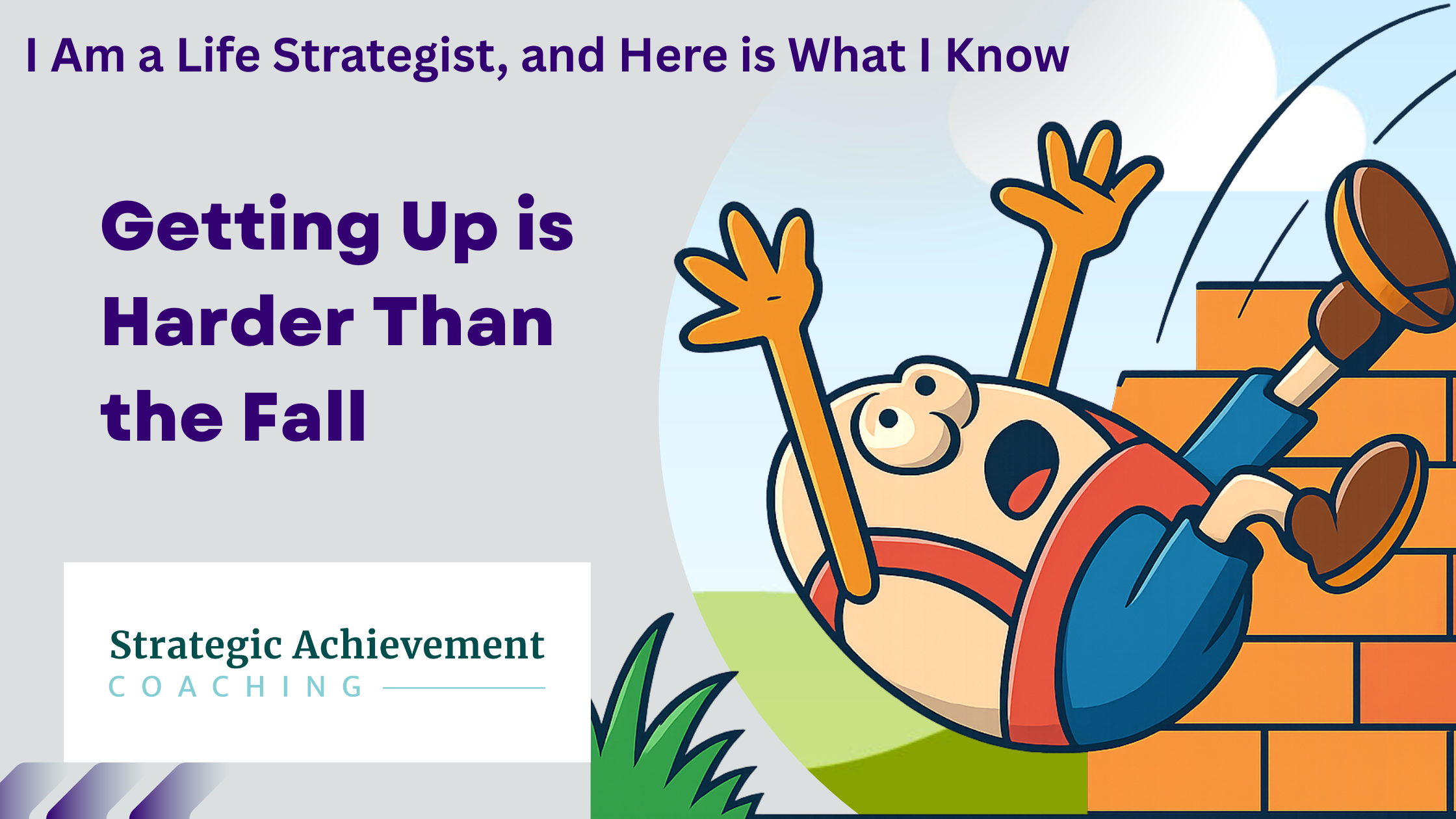
Life Strategist, Dr Carol McGowan, emphasises that getting up after a fall is harder than the fall itself. Recovery is a slow, quiet process of small, daily acts that require courage and patience. The silence that follows a fall can be challenging, but it also presents an opportunity for growth and learning. Ultimately, rising makes you stronger and more whole.
Humpty Dumpty’s story is often told as a cautionary tale about falling, about making a mistake, suffering a loss, or facing a failure so great that ‘all the king’s horses and all the king’s men couldn’t put Humpty together again.’
But the real lesson lies in what comes after. Falling happens to everyone. What truly matters is the getting back up, the slow and quiet work of piecing ourselves together again. That is the hardest part.
Perhaps the nursery rhyme ends too soon. It stops at the breaking point, without acknowledging the courage and tenacity it takes to rebuild.
The hardest part is not the fall itself, but the quiet mornings that follow, when the world keeps moving on and you cannot. It isn’t the fall that stops you; it’s the slow, clumsy process of finding the strength to stand again when your legs still feel unsteady.
When we fall, everything can feel eerily quiet, and that silence is what gets you. We often assume we’ll bounce back quickly. Sometimes we do, but often we don’t.
People will say things like, ‘You’re strong, you’ll be okay,’ or ‘You’ll be fine.’ While these words are well-intentioned, they can sometimes take away your right to be vulnerable. They imply there’s a switch you can flip to feel better, but it’s never that simple.
And then there are your own thoughts, whispering doubts about whether you can ever bounce back at all.
The silence after the fall isn’t empty; it’s full of questions you never wanted to ask:
Who am I now?
What if I don’t have the strength to rise again?
In that silence, you realise that getting back up isn’t a single act, it’s a collection of small acts over time. How long it takes is uncertain. Each morning, you decide again how you’ll show up, and the answer changes from day to day.
There is no single moment of triumph that puts you back on your feet. A burst of motivation or an inspiring quote won’t fix everything. Getting back up happens quietly, through small, almost invisible acts.
The first day might simply mean getting out of bed, taking a shower, or making a cup of coffee — and that’s okay. Gradually, you add more. Recovery is quiet and stubborn, and there is no applause for what you’re doing.
This isn’t about pretending the fall didn’t hurt; it’s about trying to stand up anyway.
I call it ‘learning to stand up straight on the inside.’ We can pretend to be brave to make the world believe we are alright, but real strength exists in standing, the kind that only you can perceive.
Some days, doing one small thing is proof that you haven’t given up.
Progress doesn’t always look like motion, but progress is progress, no matter how small the step. Over time, those steps add up. The ground stops feeling like quicksand. The sinking feeling fades.
For a long time, I believed that strength meant never failing.
Then, in my mid-fifties, I came across the quote:
‘Failure is a learning experience.’
It stopped me in my tracks. When I finally absorbed it, I felt lighter — as if a weight had been lifted. I had always thought that control and composure were what mattered most. But life taught me otherwise.
Failing is okay — if you are willing to learn from it. That is what helps you stand after the fall. It also taught me to slow down, to be mindful, and to pay attention to what was happening around me.
I stopped asking, ‘When will I be better?’ and started asking, ‘What can I learn from this?’
That shift changed everything. The pain didn’t vanish, but I found I could recover faster when I saw each fall as an opportunity to learn — not as proof of failure.
You do not rise as the same person who fell.
You rise as someone who understands both the ground and yourself a little better.
I used to think that falling was the end of the story — but it’s just the beginning. The true story unfolds in the quiet, ordinary hours when you choose, again and again, to try.
When I need reminding, I listen to Pink’s song ‘Try.’
Getting up is harder because it asks more of you. It demands patience when you crave quick relief. It requires courage when you feel you have none left. And it asks for faith — faith that you can rise, even when there’s little evidence that you will.
The fall happens quickly.
The getting up takes time.
But here’s the good news: every time you rise, even with unsteady feet, you build a life that is:
Truer
Tougher
Kinder
You haven’t erased the fall — you’ve grown around it.
In time, you’ll see that the getting up is what made you who you are.
Falls can break you.
But getting up — that’s what makes you whole again.
Take the first step towards reclaiming your power. Book your confidential consultation with Carol McGowan today.
Click here to schedule your session.
Your future self will thank you for investing in yourself now.


Subscribe to our newsletter and gain access to valuable coaching tips, resources, and updates that will empower you on your journey. Don’t miss out—sign up now and start transforming your life and career.
We value your privacy as much as you do. We will not give your email address out to any other parties.
Copyright © 2025 – Strategic Achievement Coaching. All Right Reserved
Powered by: claritycontentstudio.au

Subscribe to our newsletter and gain access to valuable coaching tips, resources, and updates that will empower you on your journey. Don’t miss out—sign up now and start transforming your life and career.
We value your privacy as much as you do. We will not give your email address out to any other parties.